Category Archives: Reviews

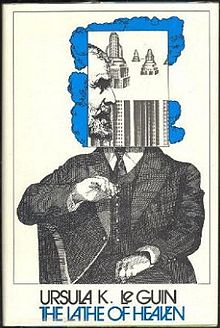
Cover of The Lathe of Heaven

The Lathe of Heaven by Ursula K. LeGuin

How in the world did Ursula K. LeGuin think that an Earth with seven billion people in it would be on the brink of starvation?

This is just one of the issues I had with one of LeGuin’s more well-known works, The Lathe of Heaven. It’s still an excellent read despite all these issues. George Orr is an ordinary man with a very weird problem. Sometimes his dreams come true. Not in the sense of prophetic dreams, but his subconscious somehow retcons the entire universe so the dream has always been true, since the dawn of time. Naturally Orr winds up referred to a psychiatrist. The psychiatrist, Dr. William Haber, starts to manipulate Orr’s dreams for his own purposes…

Over the course of the book, Orr runs through a lot of universes, exploring a bunch of mostly dystopian science fiction ideas along the way. (Notice his name is a pun on George Orwell?)

At the beginning of the book, the year is 2002 and global warming has melted all the ice in the world, including Antarctica. This is even true in realities where the human population – and thus CO2 emissions – nosedive sometime in the 1970’s. In realities where the world’s population is still seven billion, the people of Portland are crammed in so tight they can barely move, and the state of Oregon has to build several more cities in the desert, each containing millions of people.

I can’t fault LeGuin for getting the details of global warming wrong, since this book was published in 1971. But she’s too smart to miscalculate how many people a world can physically hold. All one needs to figure that out is the square footage of a typical one-bedroom apartment, the square footage of the world’s urban areas, and some math.

Another objection I have is to Dr. Haber. The book’s meant to present a moral dilemma: How far would you go to make the world a better place? That’s a fine dilemma and one I’d like to see explored. Dr. Haber’s meant to be a sympathetic character who makes questionable choices. But in practice, Dr. Haber behaves so despicably that this book does not work for me as a dilemma.

I am a scientist. I have a thing about scientific ethics. And Dr. Haber blazes past the bounds of acceptable behavior within the first dozen pages. He is literally performing medical experimentation on an unwilling patient with no protocol, no control group, and no institutional oversight. And he’s stupid. When one of his experiments on Orr kills six billion people, does it occur to Dr. Haber that this project is dangerous and he should stop? No.

There’s merit to watching a monster version of my own profession in action. And Dr. Haber makes a great villain. But a moral dilemma he does not make. I want to see him squashed like a bug. (I found the end of the book quite satisfying, but I’ll leave the reader to discover the details on their own.)

The Lathe of Heaven is meant to critique utilitarian ethics. But like I said earlier, Dr. Haber inadvertently kills six billion people for the sake of the remaining one billion. Sacrificing the many for the sake of the few is far from a utilitarian ideal. One of LeGuin’s short stories, “The Ones Who Walk Away From Omelas,” does a much better job of critiquing utilitarianism.

And LeGuin puts Taoist philosophy into characters’ mouths when they don’t have any in-universe reason to know these things.

But that’s enough ranting for now. Though I have all these objections to the book, at no point does LeGuin slip into shoddy writing. The book’s beautiful. And I disagree with it. And I like it when books bite back.

It’s wonderfully ambiguous what’s actually going on with Orr’s mind. There is a Blade-Runner-like blink-and-you’ll-miss-it moment at the beginning of the book that changes everything.

All the universes Orr surfs through remind us how weird our universe is compared to what science fiction writers expected. We live in the world where the Soviet Union sort of evaporated in 1991. Where obesity now poses a greater worldwide health burden than undernutrition. Where Eastern Europe and Japan aren’t having enough babies. Where it’s 2015 and we still haven’t conquered space, but we’re still managing to do some really awesome things with it.
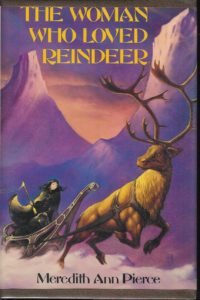

Cover of The Woman Who Loved Reindeer

The Woman Who Loved Reindeer by Meredith Ann Pierce

Uncomfortable love story, really cool setting.

I loved Meredith Ann Pierce’s Darkangel Trilogy when I was a kid. Hoping for more awesomeness, I’ve read a few of her other works over the years. Each time, I’m unhappy to find out that she seems to have pulled a Shyamalan: she’s good at one specific thing, which made The Darkangel so special, but when she tries to do the same thing in other books it doesn’t work. Her literary career seems to have petered out in 2004.

The same applies to The Woman Who Loved Reindeer.

A girl named Caribou is orphaned in her teens and the villagers refuse to take her in because she’s a seer and they’re a little afraid of her. She gets by living alone outside of town. One day Caribou’s sister-in-law Branja shows up. Branja has been charmed and impregnated by a trangl, a kind of were-deer in his human form. Branja managed to hide the pregnancy from her husband over a long hunting trip, but now she needs to get rid of the baby. Caribou reluctantly takes the baby in and names him Reindeer.

Part of what follows is a really cool adventure story. Volcanoes are taking over Caribou and Reindeer’s homeland, so Caribou uses her witch-powers and Reindeer uses his were-deer-powers to lead their people to safety. Lots of explodiness and epic crossing country scenes. There’s also a romance plot that I don’t like. It’s between Caribou and Reindeer.

Here are just a few of the problems I have with that:

  • Caribou is legally Reindeer’s aunt,
  • She raised him like a son, including breastfeeding him,
  • She’s twenty-eight years old and he is fifteen when they start having sex,
  • Caribou ate Reindeer’s father. (She thought he was an ordinary deer at the time, but still, she eventually figures it out.)

There’s also no earthly explanation why they love each other that way. Shared interests? Tender moments? Not really, Caribou just panics whenever she thinks Reindeer is going to leave her.

But gosh, the world Pierce has created is so cool. Caribou belongs to a hunting and farming community who live on a volcanically active polar continent. It’s got two fertile regions separated from each other by the pole itself, which is partially underwater. The book contains beautiful descriptions of the terrain and the adaptations of the people’s culture and lifestyle. I wanted to see lots more of that, but unfortunately it’s not the focus of the book.

I think The Woman Who Loved Reindeer would have been improved if told as a regular mother and son story. Reindeer has to grow up and run with the reindeer herd and Caribou has to learn to let him go. It would also have been better if Pierce had not tried so hard to make this into a fairy tale, because it isn’t, it’s an adventure story.

Cover of The Martian

The Martian by Andy Weir

Ever gotten a few pages into a book and recognized something you learned about from Kerbal Space Program? I didn’t realize how awesome that would feel until I read The Martian.

Some time in the near future, NASA has organized a manned Mars space program. The first two Ares missions go off without a hitch. On the third, a freak dust storm on the surface of Mars forces the crew to ditch the mission early. An antenna breaks off in the wind and impales astronaut Mark Watney. He goes down and his suit’s vital signs blink out. The rest of the crew don’t have time to recover the body, so they leave.

There’s a problem. Mark Watney’s still alive.

Just … how did Andy Weir manage to make a space disaster thriller hilarious? Watney accepts the fact that he’s probably going to starve to death with surprising aplomb. His mission log entries are the high point of the book. The book’s told in a highly unconventional mix of first person (Watney’s snark), third person (NASA officials, who are freaking out), and omniscient (what’s going on with equipment and unmanned probes). Weir shouldn’t get away with it, but he does because it’s so very entertaining.

You’ll want to read this book if you want to know how a manned mission to Mars would work. Weir’s thought the details through. This book sent me to Wikipedia a lot, and while I don’t understand all of the science, it’s rock-hard. Yet it’s not dry and technical. Weir manages to make nail-biting tension out of Hohmann transfer windows.

If you wanted to know what a mission to Mars would look like, though, you won’t find out here. For example, here’s a description of the Hermes, the spacecraft the Ares crew used to get to Mars:

The Hermes crew enjoyed their scant personal time in an area called “The Rec.” Consisting of a table and barely enough room to seat six, it ranked low in gravity priority. Its position amidships granted it a mere 0.2g.

This is the most extensive description of the Hermes in the book. The Martian surface doesn’t fare much better.

I also have a pet peeve about Vogel’s broken English. His grammar is ridiculously bad for someone who has spent months of mission time and years of training time using English exclusively to communicate. If NASA had caught him saying things like “Very important is thirteen centimeters,” they would have kicked him off the mission.

But that’s a minor point. The Martian is the most entertaining hard science fiction I’ve read in a long time.

Edit: NASA just announced they found evidence of liquid water on Mars. The timing couldn’t be better.

Cover of The Yiddish Policemen's Union

The Yiddish Policemen’s Union by Michael Chabon

I don’t usually write DNF reviews, but this has got to be one of the best books I couldn’t get through.

In an alternate 1940, the U.S. government decides to allow European Jews to set up a temporary homeland in the panhandle of Alaska. One the one hand, four million of the six million Jews killed in our timeline escape the war and survive. On the other hand, on January 1, 2008, their lease will expire and they will be screwed yet again. (Israel doesn’t work out so well.)

The premise is absolutely brilliant and I wanted so much to read this book. But I can’t. Get. Through. The. Prose. It is so dense. Chabon describes every little thing. Reading The Yiddish Policemen’s Union is like trying to eat an entire chocolate flourless torte – a little bit is delightful. Chapter five, the backstory about Meyer Landsman’s relationship with his father and chess, would have made a great short story on its own. It’s also the point at which I gave up.

If you like alternate history and you can hack the prose, I recommend it. But if you can’t, don’t feel too bad.

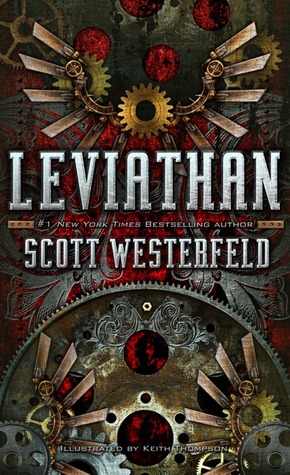
Cover of Leviathan

Leviathan by Scott Westerfeld

A surprisingly okay book, given its awesome premise.

The year is 1914. The assassination of Archduke Ferdinand and his wife Sophie causes the great powers of Europe to lurch towards war. The Central Powers wield clankers, gigantic walking war machines and the Allies use beasites, genetically engineered creatures that have been turned into weapons. AWESOME.

Westerfeld takes those elements and weaves a pretty conventional story with them. Deryn Sharp a plucky girl (conveniently an orphan) disguises herself as a boy to join the British Air Service. Aleksander Hapsburg (conveniently made into an orphan at the start of the book) flees assassins who want to finish the job. Their fates entwine, they put aside their national and technological differences, they become friends. Add a lady scientist and a couple faithful family retainers, and all the story needs to complete the cliché picture is a smart-talking chimney sweep.

But it’s an all right book. The writing is solid. Alek starts out as a brat, but he mellows out over the course of the story. I like how Westerfeld takes the language barrier these two characters would have had and uses it as part of the plot. And the genetically-engineered gasbag creatures that the British use as war machines? They call them Huxleys. That’s brilliant.

But it could’ve been so much more. For one thing, there’s no good reason for the clanker-wielding and beastie-wielding people to hate each other. The two technologies line up on the sides that real life countries did in WWI – even though they would have had to develop the technologies decades before a war that nobody saw coming. I would have loved to see the technologies line up along Catholic/Protestant lines. Or manipulation of the beasties equated with social Darwinism and the rest of the world’s horrified reaction to it.

Characters cussing with “Clart!” and “Barking spiders!” gets old pretty fast. And there’s a war on and nobody besides main characters’ parents ever gets killed.

I still recommend it. Most steampunk works shy away from WWI. This book explores the boundaries of what’s possible with the genre.

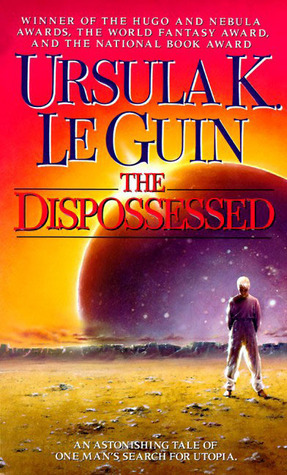
Cover of The Dispossessed

The Dispossessed by Ursula K LeGuin

The Dispossessed is the reason Ursula K. LeGuin became the first person ever to write a book that won both the Hugo and the Nebula Awards, twice. (Her first twofer was for The Left Hand of Darkness.) She earned it.

The book is circular on a lot of levels. The story deals with a binary system of planets, Urras and Anarres, that orbit the star Tau Ceti. The inhabitants of each planet see the other planet as the moon. Urras is a lush water planet with a capitalist society and a state-socialist society locked in a cold war with each other. (Sound familiar? The book was published in 1974.) Anarres is a desert world inhabited by the descendants of colonists who exiled themselves on the planet to found an anarcho-syndicalist utopia.

I didn’t know anarcho-syndicalism existed until I started reading. It’s sort of like rule by a federation of trade unions. Sort of, but not exactly. The examination of these three societies makes the book a morality play on an epic scale, which shouldn’t work, but it does.

The main character is Shevek, an Anarresti physicist who travels to Urras after the planets have been isolated from each other for 170 years. In alternating chapters the book tells of Shevek’s adventures on Urras and his backstory on Anarres that led to his decision to make the trip. At the end of the book, Shevek returns to Anarres at the same time that he decides to leave Anarres for Urras. Circular.

Often, LeGuin would meet my objections to how Anarresti society would work just after I thought of them.

Me: How does a hermit society like Anarres do physics?

LeGuin: Yes, that’s the problem.

Me: But this isn’t really an anarchy! The government’s just very small and decentralized.

LeGuin: Yes, and it’s getting bigger.

I have some other issues with the text that LeGuin didn’t address. Why don’t Anarresti people work themselves sick, for instance? There’s always too much work to do just to survive in the planet’s harsh climate. Anarresti are taught from childhood that work is the noblest thing a person can do with their time. But it says in the text that they have a six-hour workday. Maybe they don’t take weekends.

Since there’s no central court of justice, rapists and murderers have to face the wrath of their neighbors. Regardless of how comfortable you are with vigilante justice, what if the community is wrong about who did it? What if they are really, truly convinced they have the culprit, and he didn’t do it?

I also don’t think it was entirely sporting of LeGuin to make the capitalist society the worst capitalist society that could possibly exist. A-io is only a few steps away from being a medieval feudal society with spaceships.

But all these are quibbles. The descriptions of place are gorgeous, and this book will make you think. Hard. And that’s the best kind of science fiction.

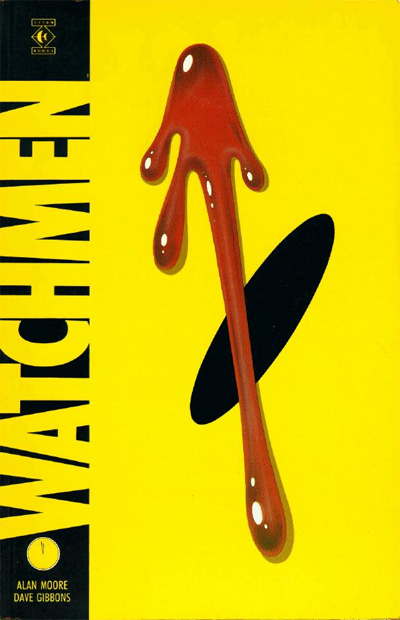
Cover of Watchmen

Watchmen by Alan Moore

Minor spoilers.

A work that gets a lot of hype, especially in the graphic novel community. Is Watchmen the greatest graphic novel ever written? I dunno. But it is damn good. Good enough that you could have a healthy discussion of it in an English Literature class.

Watchmen is set in an alternate universe where, like in our world, superhero comics hit the newsstands around the time of WWII. But then in their world people take it upon themselves to actually do masked crime fighting and the fictional heroes fade away. None of these masked heroes has superpowers (except for one of them), they have all too human failings, and they may have wound up doing more harm than good.

Watchmen was published as a serial in 1986-87 and as such captures the very essence of Cold War paranoia. It’s strange to think that a couple of years before I was born, people were walking around thinking that they could be vaporized at any moment. The moment when I most felt like an alien reading about another planet was during a phone call. One of the characters has to button the call off because calling California is so expensive.

Gosh, it’s clever. I recommend reading it over twice so you catch all the sight gags. The Indian restaurant where some of the characters meet is the Gunga Diner. A retired heroine is hanging out at the Nepenthe Gardens. One of the masked heroes names himself Ozymandias and fails to see the problem with that.

You’ll also want to see the ending. There’s a subversion of the villain’s monologue of epic proportions.

I have a couple of quibbles with the text. Dr. Manhattan regains interest in life on earth because every person born on earth is a statistical impossibility. They’re not. Once life gets started, it makes damn sure it keeps going. I also don’t buy the plot to make him leave Earth in the first place by convincing him he’s giving people cancer. All anybody had to do was hold a Geiger counter up to him and they’d see he’s not radioactive.

On the whole, though, it’s delicious with literary references, shocking, and will never really let you think about superheroes the same way again.

Cover of Night Watch

Night Watch by Terry Pratchett

I decided to read this book in honor of the late and great Terry Pratchett. I’d read it described on TvTropes as one of his best books. How I felt about it? It’s good, but Going Postal is still my favorite.

Sam Vimes is chasing a cop-killer named Carcer across the rooftops of the High Energy Magic Building when a lightning strike sends them both thirty years back in time to the bad old days of Ankh-Morpork. Vimes has to figure out how to get home and keep Carcer from dooming history.

The book is unevenly good. The beginning didn’t do much for me, and it won’t make sense for people who haven’t read the other books about the Watch anyway. It picks up when the actual time travel happens. The Ankh-Morpork of Vimes’s youth is in much worse shape than it is in the present day – it drives home how much Vetinari has accomplished during his time in power. It helps to be familiar with Les Miserables to get the full enjoyment of the book.

And then there’s the scene where Vimes and the younger version of himself find Findthee Swing’s special basement. That scene blew me away. Very little is actually described. It’s a master example of leaving details out to make a story more scary.

We’re also treated to a view of Reg Shoe in life. And we get to witness his finest moment, the one at which he becomes a zombie. But then the action moves away from him. Inquiring minds want to know what his first few days as a zombie were like. Did he freak out? (I would.) How did he figure out how to keep himself from rotting? I like to imagine some kind undertaker took him under wing and explained the facts of undeath.

Night Watch manages to be both dark and funny. It’s just as worth reading as all of Terry Pratchett’s stuff.

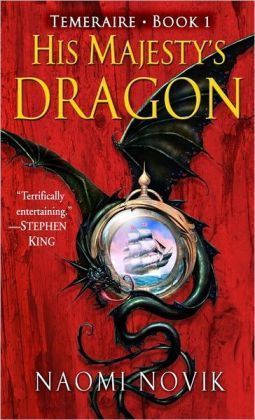
Cover of His Majesty's Dragon

His Majesty’s Dragon by Naomi Novik

I’ve read reviews of His Majesty’s Dragon that describe it as a what-if book. That is, “What if the Napoleonic Wars were fought with dragons?” It does that, but while it’s at it it inadvertently addresses what I think is a much more interesting question: “What if air power had been an important part of European warfare 110 years early?”

The book starts out in a Horatio Hornblower universe and a genre shift creeps up on the reader gradually. William Laurence, British naval captain, captures a French ship with a dragon’s egg on board. Unfortunately, the egg’s about to hatch. Somebody on board must harness the dragon or they risk letting it go feral. The dragon chooses Laurence for a rider and he’s thrust into the Royal Air Corps.

You’ll either love the prose or hate it. The book is deliberately written in the style of novels from the early 1800’s, with long, flowery sentences that’ll leave you wondering where the verb went. I happened to like it. The book is not as stodgy as it sounds (Novik keeps the plot moving along at a modern pace). I was impressed with the technical skill it too for a modern-day American woman to bring us so thoroughly into the head of 1800’s British sea captain, complete with prejudices of the era, and we can still like him.

The plot isn’t remarkable. Laurence and his dragon Temeraire find their way around the Air Corps and eventually get accepted by their new comrades after a climactic battle against Napoleon’s forces. It’s a thin excuse for a guided tour of an R.A.F. with dragons. Novik has thought military strategy with dragons through. You’ll be treated to demonstrations of how air forces assist naval forces, how the government feeds an army of gigantic carnivores, midair safety (carabiners are a big deal), and 3-D midair maneuvers. Read it as alternate history porn and you’ll have a fine old time.

If Novik was going to be really realistic, both England and France would breed the smallest, lightest dragons possible, bomb the other sides’ civilians in the middle of the night, then run like hell. But then the dragons would be sentient airplanes and that wouldn’t be as much fun.

The most annoying moments of the book come when Novik injects twenty-first century sensibilities into the story. Some breeds of dragons will only accept female riders, so women are required to serve in the Air Corps. Laurence has to get over his prejudices and accept his female colleagues. It’s a bit much. Some of the exposition says that women riders have been around since the time of Elizabeth I, so shouldn’t the English people have culturally adapted by then? Perhaps by developing a tradition of shield maidens, like the Vikings did. I would rather have seen female aviators with a defined role in society or seen the book gone for total historical accuracy. As it is, the book is trying to have it both ways and it feels like cheating.

Also, Temeraire the dragon is too damned special. Not only is he the only Chinese dragon in the West, he’s a Celestial, the most special of the Chinese breeds, and he keeps coming up with new abilities that confound his trainers. At the big battle scene at the end he pulls a new superpower out of his ass that saves the day.

On the other hand, it didn’t bother me at all that these behemoths couldn’t possibly fly. It’s magic! Whatever. I thoroughly enjoyed it, but I don’t think I’ll be going for the sequels.

A Circus of Brass and Bone by Abra Staffin-Wiebe

24161438Full disclosure: Abra’s a friend of mine. I’m going to give this book an honest review, though.

Do you have a morbid sense of humor? A Circus of Brass and Bone is great for that. A troupe of circus performers, on a return trip from a tour in India, arrive in Boston Harbor only to discover the end of the world happened while they were at sea. The book’s cast of misfits have to figure out how to live in a world where people want to know where to buy all the dead bodies, not watch a circus.

What I like best about the book is that it doesn’t take itself too seriously. It’s nominally steampunk, but the punk-y elements are woven seamlessly into the background. (Look at me! Look at me! I’m wearing a corset! is thankfully nowhere to be found.) Most of the time, Brass and Bone bears more resemblance to Shaun of the Dead than The Difference Engine. And then at times the book gets very serious and punches you in the gut when you weren’t looking.

There’s a moment near the beginning of the book where it is just beginning to dawn on the circus performers that half the city of Boston is dead. What does the narrative focus on? The skeleton man skulking around trying to steal chocolates from the fat lady. Is there something wrong with me that I was giggling like an idiot? Perhaps.

Staffin-Wiebe writes flawed characters well. Everyone in the circus has something the matter with them so they can’t get a job anywhere else. It’s tempting for a writer to give women and minority characters a free pass just to prove that they’re with the times, but in Brass and Bone, they’re just as human as the rest of the cast.

My biggest complaint is that the book went by too fast. I’m not sure if extra text got left on the editor’s chopping block or it wasn’t written in the first place, but it felt like there was supposed to be more. I think it’s especially important to flesh out the story because there are so many point of view characters. Some of them are there and gone before you ever get to know them.

There was also a moment where Lacey, the circus’s equestrienne, comes riding into New York City on a white horse. I thought white horses didn’t exist, so I Wikipedia’d that, and it turns out they’re just rare. Rare enough that I started writing this paragraph to point out a research blooper, and now I’m wondering whether there’s more to Lacey than meets the eye.

Anyway, the book is funny and it has zombie deer in it. Worth reading.