
Check out this interview Jerome Brooke did with me on his blog!
Monthly Archives: May 2014
Interview with Jerome Brooke
 Jerome Brooke is a fellow Goodreads author who agreed to do an interview swap with me. He writes dark and erotic fantasy fiction, set in an alternate ancient world. Here’s what he had to say when I interviewed him about his work:
I noticed your books’ subject matter tends towards vast empires, warriors, warrior-priestesses, and dark rituals. Are you inspired by golden-era pulps like Conan the Barbarian and The Dying Earth?
I use the Conan tales as a model – long novels do not work with ebooks – on Amazon, longer paperbacks are expensive – So, I write short stories or novelettes – tales that can be read as solo texts – but have serial elements – and have narrative elements. Like Conan or Sherlock Holmes, the stories read as a group resemble novels or television serials.
Your stories take place in an alternate ancient world. How close to you stick to real historical events?
I use traditions, myths and other historical elements. For example, people may wear Roman togas etc.
How do you do your research?
I may check a fact in Wikipedia.
Are there any special challenges to writing erotic fiction?
I have had stories under contract with publishers, with rewrites, and even had artwork done. But had publishers cancel. This is true for “sexy nuns” stories or interracial taboo topics.
I noticed Good Samaritan Press, your publisher, is based in Thailand. How did you find them?
I have operated GSPress myself for many years.
.
And there you have it. If you’re interested in learning more about Jerome Brooke’s writing, you can check out his page on Goodreads.
Stand Still, Stay Silent

That’s the face of a dark, grim future right there.
Some time in our near future, a super flu kills off most of the people in the world. A handful of Scandinavians survive by dint of living on remote islands and being really tough people to begin with. Meanwhile, the magic of Nordic mythology, including mages, seers, and trolls, begins to wake back up.
Sounds pretty dark, right? Oddly enough, Stand Still, Stay Silent, a new webcomic by Minna Sundberg, isn’t. The main story’s set ninety years after the plague, and although humanity’s settlements are small and scattered, people live pretty well. The government of Iceland is finally willing to fund a research expedition to the forbidden zone, the Silent Lands. The budget they cough up is woefully short (you know academia so well, Minna!), so the expedition’s organizers can only afford to hire complete dorks. Enter our cast.
This webcomic’s beautiful. It’s like going on an armchair vacation to see the stark landscapes up at the top of the world, and since the artist’s a Swede who grew up in Finland, you know she knows what she’s talking about. On top of that, the comic’s got an impressive update schedule of four full-size, color pages a week.
If you want to check out this webcomic, here’s a couple pieces of advice before going in. First, feel free to start on page 56. The pages before that deal with the end of the old world, and if you’re passingly familiar with The Stand or World War Z, you already know everything you need to know. The really interesting part is the new world that takes its place. Second, Minna Sundberg loves to draw characters with fine, delicate chins and medium-ish hair. On top of that, they’re all wearing furs. If you want to keep track of characters’ genders, you may want to take notes.
The main story’s just setting up, and Sundberg has given us some tantalizing hints about this world. Why are they called the Silent Lands? Something about the monsters responding to human speech.
Free Review Copy of Cannon Fodder
Are you on Goodreads? Do you want a free copy of Cannon Fodder? For the next few weeks, I’m giving away free copies of Cannon Fodder on Goodreads in exchange for an honest review. If you’ve been on the fence about picking up a copy, and you like being opinionated about books, here’s your chance.
Check it out here on Goodreads.
Minneapolis May Day Parade
Last week, Vu and I went to Minneapolis’s 40th annual May Day Parade. Organized by the In the Heart of the Beast Puppet Theater, the parade’s made out of puppet shows, paiper maché, and in the Free Speech section, anybody who has an axe to grind for a particular cause. They march down Bloomington Avenue until they reach Powderhorn Park for a festival.
Both of us had a blast.

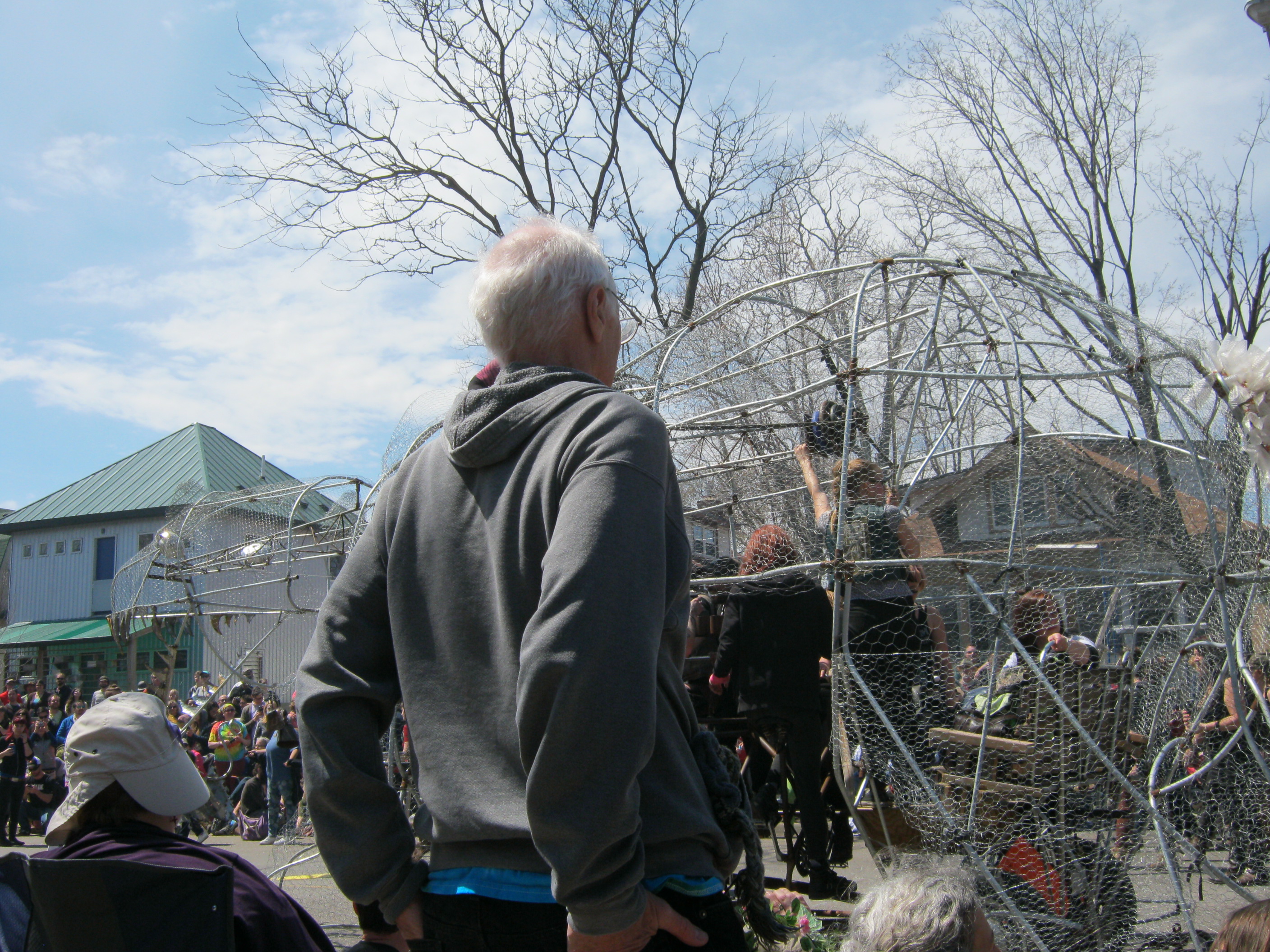
It’s hard to see in these pics, but this was a really cool wire dragon.


If you ever wondered whether the Twin Cities were a left-leaning area, now you know.

Either these people have never seen Dr. Strangelove or Spaceballs, or they just don’t care.
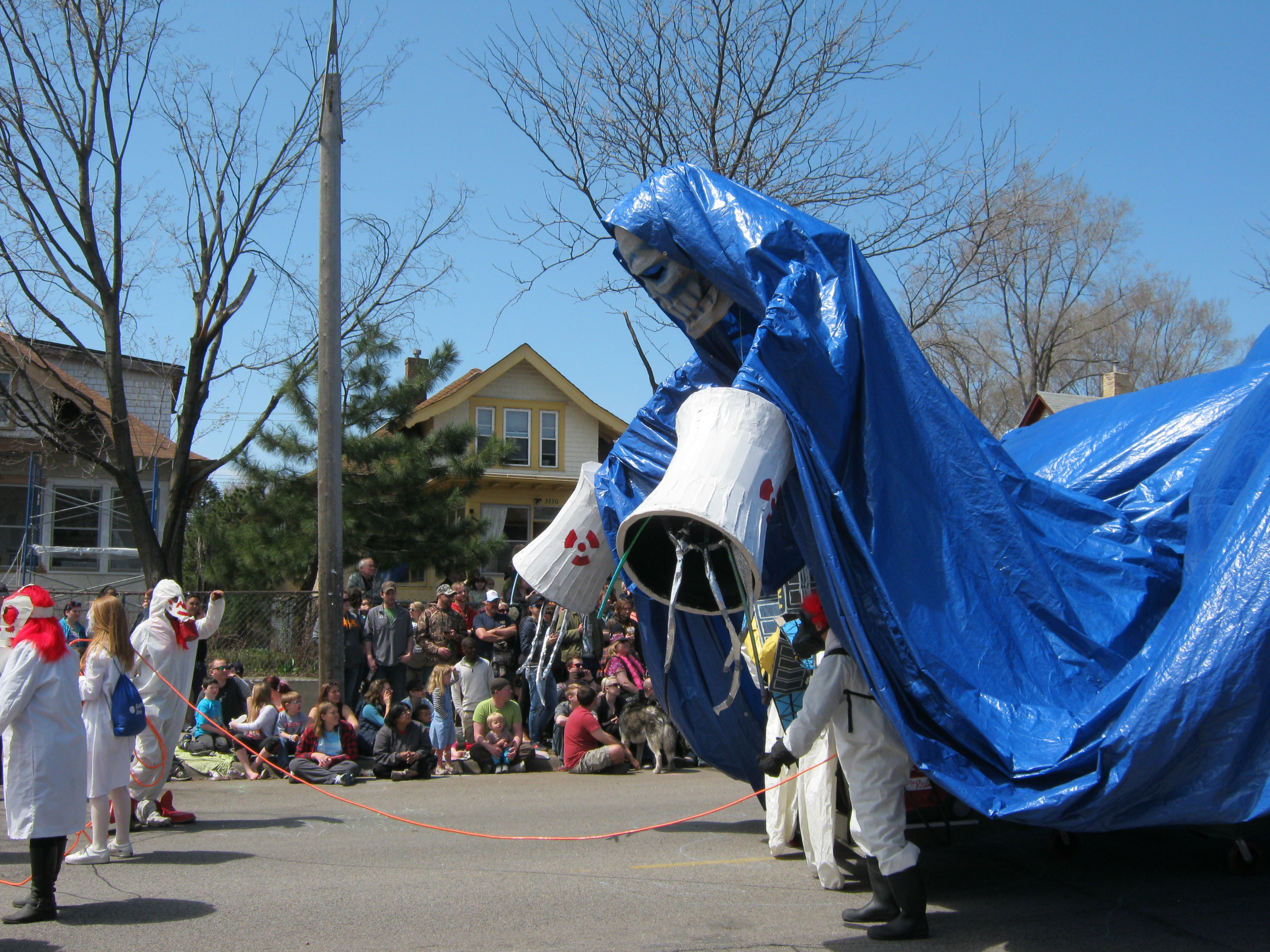

… I have no idea.

These folks were in favor of solar power.

Here you can see the muffin boy, who I think was supposed to be a mushroom.

May poles.

I’m not sure who the worm dude is, but in the background you can see a child being a lichen.



These Aztec dancers were in favor of reuniting families across the U.S.-Mexican border.

They wanted to raise the minimum wage to $15 an hour. Good luck with that.

The Green Party

Yup.

Did I mention it’s a left-leaning city?
Farthing by Jo Walton
 Jo Walton’s a badly underrated writer. She’s not underrated by speculative fiction awards committees, just the public consciousness. Since the start of her career in 2000, Walton has won the World Fantasy Award, the Prometheus Award, the Nebula, and the Hugo (these last two for the same book). She could be the most decorated author you’ve never heard of.
Which is a shame. Walton does fluffy society novels, but twists them in ways you’ve never seen before. I was first introduced to her work by her 2002 novel, Tooth and Claw. It’s Pride and Prejudice if every character in it were a dragon. It’s a world where a maiden dragon’s need to maintain her “virtue” is dictated not just by custom but by biological reality.
Farthing starts out like a fluffy society novel, too. It’s set in an alternate 1949 where Britain and the Third Reich have fought it out to a draw and signed a peace treaty. At the start of our book, a bunch of flighty British nobles are cooped up in a friend’s country house for a weekend party. Sunday morning, one of the upper-class twits is discovered dead. While Inspector Carmichael tries to solve the mystery, he’s exposed to the antics of Lucy Kahn, née Eversley, a debutante who married a Jewish man, and her mother, who’s never forgiven Lucy for it. He wades through speculation about who’s sleeping with whose sister, who’s sleeping with whose servant, and who’s sleeping with other men. We see upstairs-downstairs as the servants split into factions, the ones who support Lucy’s marriage and the ones who don’t. There’s also a lot of wrangling over the difference between India tea and China tea, which still leaves me puzzled. Are these black tea and green tea, respectively?
It’s all quite amusing and fluffy until it slowly dawns on you that George Orwell is writing the novel.
That’s all I’ll say about how it ends. Though it’s a testament to Walton’s skill as a writer that while this is technically a sad ending, she manages to fill it with so much hope.